
The Board Question
A red-team report notes that "eng build" Kubernetes nodes can break out to the host via a poorly confined privileged container. Finance laptops show policy drift — host firewalls off, HIPS stale, FIM baselines missing. Sales are syncing PII to a shadow SaaS app.
The board just asked: "Are we safe in the cloud?"
Anya's answer: "We need one map that ties all of this together."
Modern enterprises don't run on one computer or one tidy app. They run on layers: hypervisors, containers, microservices, SaaS, mobiles, and clients scattered across countries. Each layer adds power and new places to fail. Your job isn't just to "turn on controls." It's to understand where isolation breaks, where defaults leak, and where shared responsibility is silently handing you the knife by the blade.
Virtualization vs Containers vs Microservices
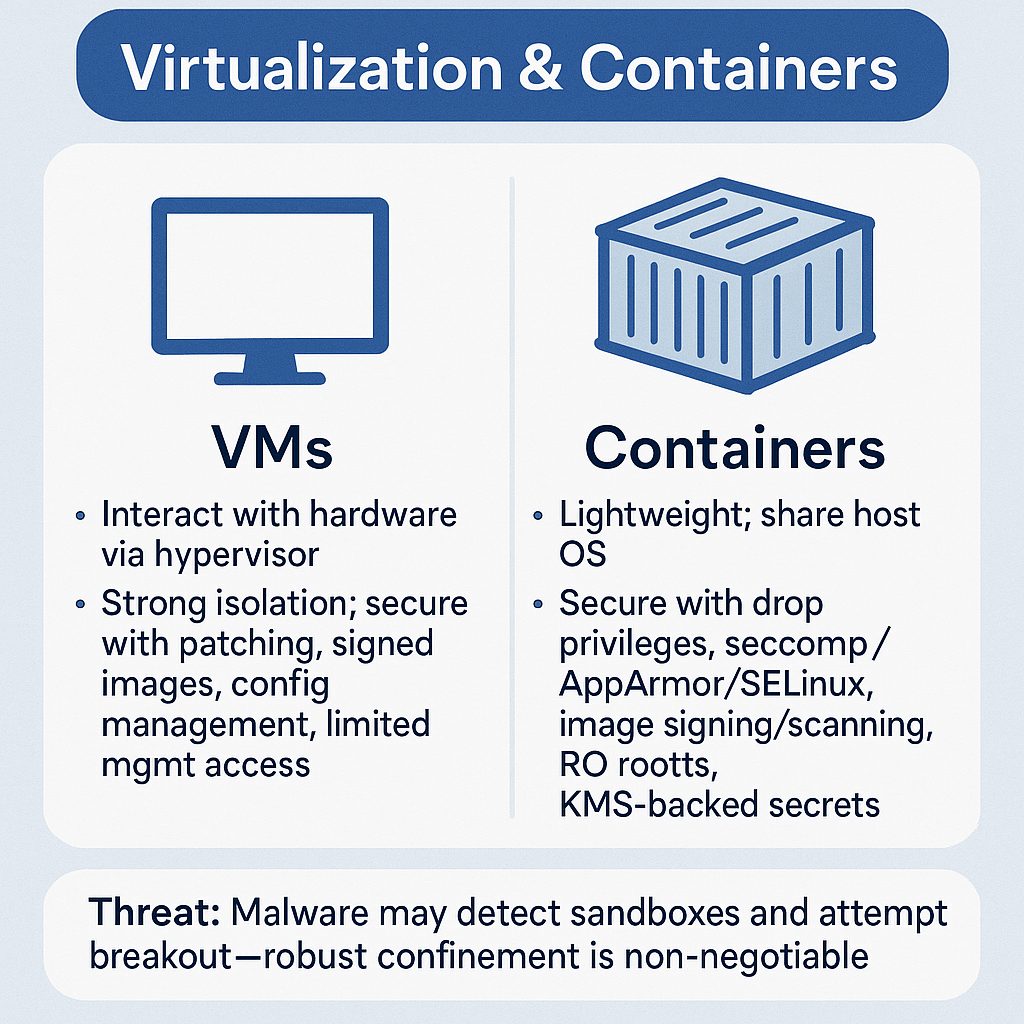
Virtual Machines (VMs)
- What they are: Software emulation of a full OS on a hypervisor
- Isolation: Strong — guest OS boundary via hypervisor
- Key risks: VM escape, snapshot sprawl, stale "gold images," management plane exposure
- Controls: Hardened hypervisor; signed images with version control; least privilege to management APIs; consistent patch cadence; remove dormant snapshots
Containers
- What they are: App + libraries packaged together; shares the host OS kernel
- Isolation: Moderate — namespace/cgroups; weaker than a hypervisor boundary
- Key risks: Privileged containers, kernel CVEs, noisy-neighbour effects, weak registry hygiene
- Controls: Drop privileges; seccomp/AppArmor/SELinux profiles; image signing and scanning; read-only root filesystem; KMS-backed secrets management
Microservices
- What they are: Small, independent services communicating via APIs — no shared state
- Isolation: Logical API boundary — not a kernel or OS wall
- Key risks: Over-permissive service accounts, authn/authz gaps between services, SSRF, lateral movement via service mesh
- Controls: TLS service mesh (mTLS), zero trust between services, least-privilege scoped tokens, explicit API schemas, rate limits
As you move "up" the stack (VMs → containers → microservices), speed increases and implicit boundaries weaken. You must add strong identity, policy, and runtime controls to compensate.
Top Threat Actions and Mitigations
| Threat Action | Where It Bites | Why It Works | Mitigations That Matter |
|---|---|---|---|
| Breakout / Escape VM → host; container → host |
Hypervisor, container runtime | Weak confinement; kernel bugs; privileged flags | Patch hypervisor/runtime; disallow privileged containers; enable SELinux/AppArmor/seccomp; strict syscall allowlists |
| Shadow IT / SaaS exfil | Cloud apps | Unmonitored data flows, no DLP | CASB for discovery/DLP; per-app OAuth governance; least-privilege scopes; data classification and policy |
| Config Drift | Endpoints, servers | "Temporary" tweaks that stick | Config and policy monitor; CIS baselines; immutable infrastructure; drift alerts with auto-remediation |
| Credential Stuffing / Phishing | Users, service accounts | Weak MFA, token sprawl | Phishing-resistant MFA; scoped tokens; JIT access; secrets rotation; device posture checks |
| Eavesdropping / MITM | Mobile, Wi-Fi | Open or rogue networks | VPN + TLS everywhere; HSTS; Wi-Fi EAP-TLS; disable legacy ciphers; MDM to kill promiscuous network joining |
Host Protection Stack
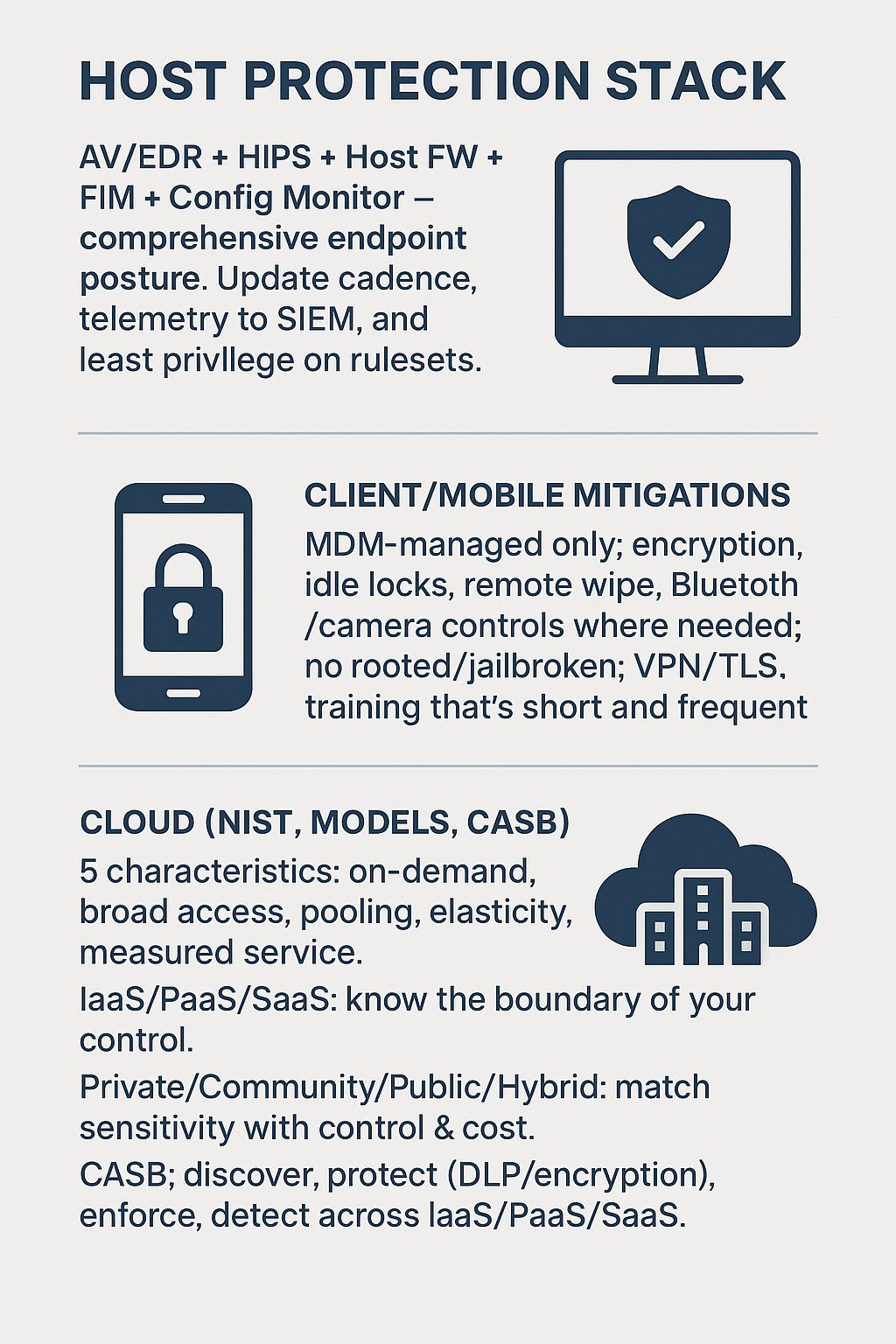
- Antivirus / Anti-malware: Signature + heuristic detection. Only as good as updates and behaviour detection — don't rely on signatures alone.
- HIPS (Host Intrusion Prevention System): Blocks suspicious actions (buffer overflow, privilege escalation). Complements NIPS. Tune to reduce false positives.
- Host Firewall: Enforces inbound/outbound policy. Default-deny egress stops a surprising amount of C2 traffic.
- FIM (File Integrity Monitoring): Detects unauthorised file changes using cryptographic baselines. Point at logs, configs, and app binaries — wire alerts to incident response.
- Config/Policy Monitor: Detects drift from hardened baselines. Treat baselines as living artifacts; auto-revert when feasible.
Client and Mobile Risks and Controls
Client risks: physical loss, misuse, unapproved software, phishing clicks, locally stored secrets.
Mobile risks: loss/theft, weak access controls, unencrypted data, eavesdropping via MITM/fake APs, limited onboard security enforcement.
Controls That Actually Move Risk
- Patch/Update: OS, apps, firmware — automate the cadence.
- Network Controls: Segmentation; NIDS/NIPS; egress allowlists for SaaS.
- Endpoint Security: AV/EDR + HIPS + host firewall + full-disk encryption.
- Monitoring: Central logs + alerts (failed logins, suspicious child processes).
- User Education: Short, high-signal modules — phishing drills, USB hygiene.
- MDM for Mobile: Only managed devices get access; push policies; encrypt profiles; idle timeout and screen locks; remote wipe; camera/Bluetooth lockdown where sensitive; block jailbroken/rooted devices; geofencing for high-sensitivity roles.
Cloud Security — NIST, Models, and Reality
NIST Essential Characteristics of Cloud
- On-demand self-service
- Broad network access
- Resource pooling (multi-tenancy)
- Rapid elasticity
- Measured service
Cloud Service Models and Shared Responsibility
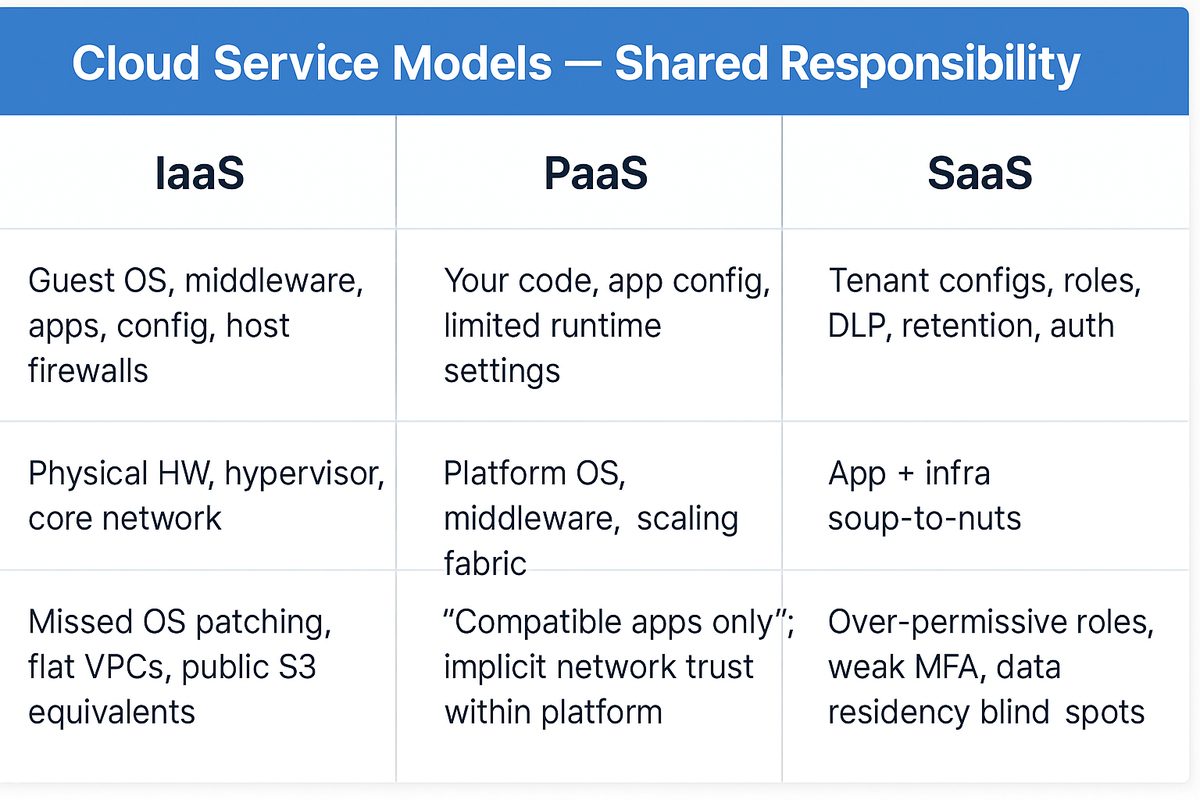
- IaaS: You own the guest OS, middleware, apps, config, and host firewalls. Provider owns physical hardware, hypervisor, core network. Common failures: missed OS patching, flat VPCs, public S3 equivalents.
- PaaS: You own your code, app config, limited runtime settings. Provider owns platform OS, middleware, and scaling fabric. Common failures: "compatible apps only" traps; implicit network trust within the platform.
- SaaS: You own tenant configs, roles, DLP rules, retention, and auth settings. Provider owns everything else. Common failures: over-permissive roles, weak MFA, data residency blind spots.
Cloud Deployment Models
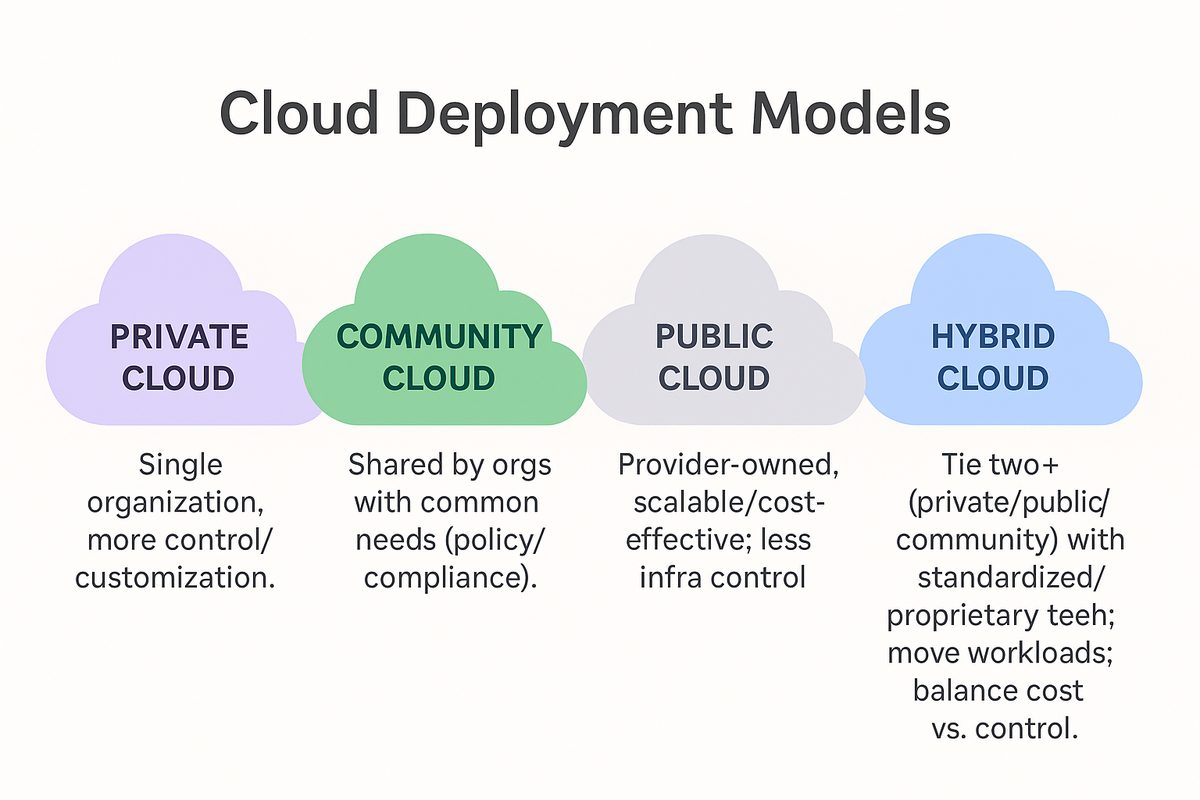
- Private Cloud: Single organisation, more control and customisation, highest cost.
- Community Cloud: Shared by organisations with common needs — policy, compliance, mission.
- Public Cloud: Provider-owned, scalable and cost-effective, less infrastructure control.
- Hybrid Cloud: Ties two or more deployment models with standardised or proprietary technology. Move workloads to balance cost vs. control — sensitive writes stay private, burst read-only workloads go public.
CASB — Cloud Access Security Broker
CASB is your visibility and policy engine sitting between users/devices and cloud services.
- Discover: Shadow apps, usage patterns, unsanctioned data flows
- Protect: DLP, encryption, token governance
- Enforce: Access policies; monitor OAuth scopes; inline or API-mode deployment
- Detect: Threats across IaaS/PaaS/SaaS — Salesforce, Google Workspace, Azure, AWS
You can't govern what you can't see. CASB is your cloud flashlight.
Neuromesh — Putting It Together
Virtualization and Containers
- Bare-metal hypervisors for production DB VMs — hardened, signed images, dormant snapshots removed
- Kubernetes: ban privileged containers; seccomp profiles; read-only root filesystems; AppArmor/SELinux; image signing + scanning before deploy; rotate secrets with managed KMS
Microservices
- Service-to-service mTLS with SPIFFE/SPIRE identities
- Replace wildcard tokens with scoped, short-lived JWTs; rate limiting and schema validation on every boundary
Endpoints
- Host firewalls default-deny egress; EDR + HIPS; FIM baselines restored
- Config monitor watches for "temporary exception" drift — creates a ticket and auto-reverts high-risk keys
Cloud and CASB
- Shadow SaaS discovered via CASB — either sanctioned with DLP and retention, or blocked
- IaaS: no flat networks; subnet segmentation; security groups default-deny; VPC egress via proxied gateways
- SaaS: phishing-resistant MFA; least-privileged roles; tenant audit logging to SIEM; data classification aligned to DLP
Cheat Sheet
Brain Ticklers
Q1. Red team shows a container can start with --privileged on Neuromesh's CI runners. What is the most effective first mitigation?
- Add more AV signatures to runner hosts
- Remove privileged container capability; enforce seccomp/AppArmor; read-only rootfs
- Move CI runners to a bigger VM
- Enable HSTS on the corporate website
Q2. Finance laptops show host firewalls disabled and FIM baselines missing after a "temporary" troubleshooting change. Which control best prevents recurrence?
- Annual security awareness training
- Config/policy monitor with auto-revert to hardened baselines
- New laptop model with faster CPUs
- Weekly manual checklist by helpdesk
Q3. Sales is using an unsanctioned cloud storage app to share prospect data. What provides visibility and enforcement with least friction?
- Block all internet access except corporate site
- CASB discovery + DLP policies + OAuth scope governance
- Move Sales to private cloud VMs
- Ask users to email files instead
Q4. An incident shows lateral movement via over-permissive service tokens in a payment microservice architecture. Best architectural fix?
- Increase pod CPU limits
- Centralise all services into a monolith
- Mutual TLS identities (SPIFFE), least-privilege tokens, and per-service ABAC
- Replace Kubernetes with bare-metal servers
Q5. Sales team members work from airports and cafés. What policy set most reduces mobile eavesdropping risk without breaking workflows?
- Disable Wi-Fi globally on mobiles
- Require VPN; enforce TLS; MDM-pushed Wi-Fi profiles; block open SSIDs; screen lock + remote wipe
- Ask employees to be careful with Wi-Fi
- Move all apps to on-prem only
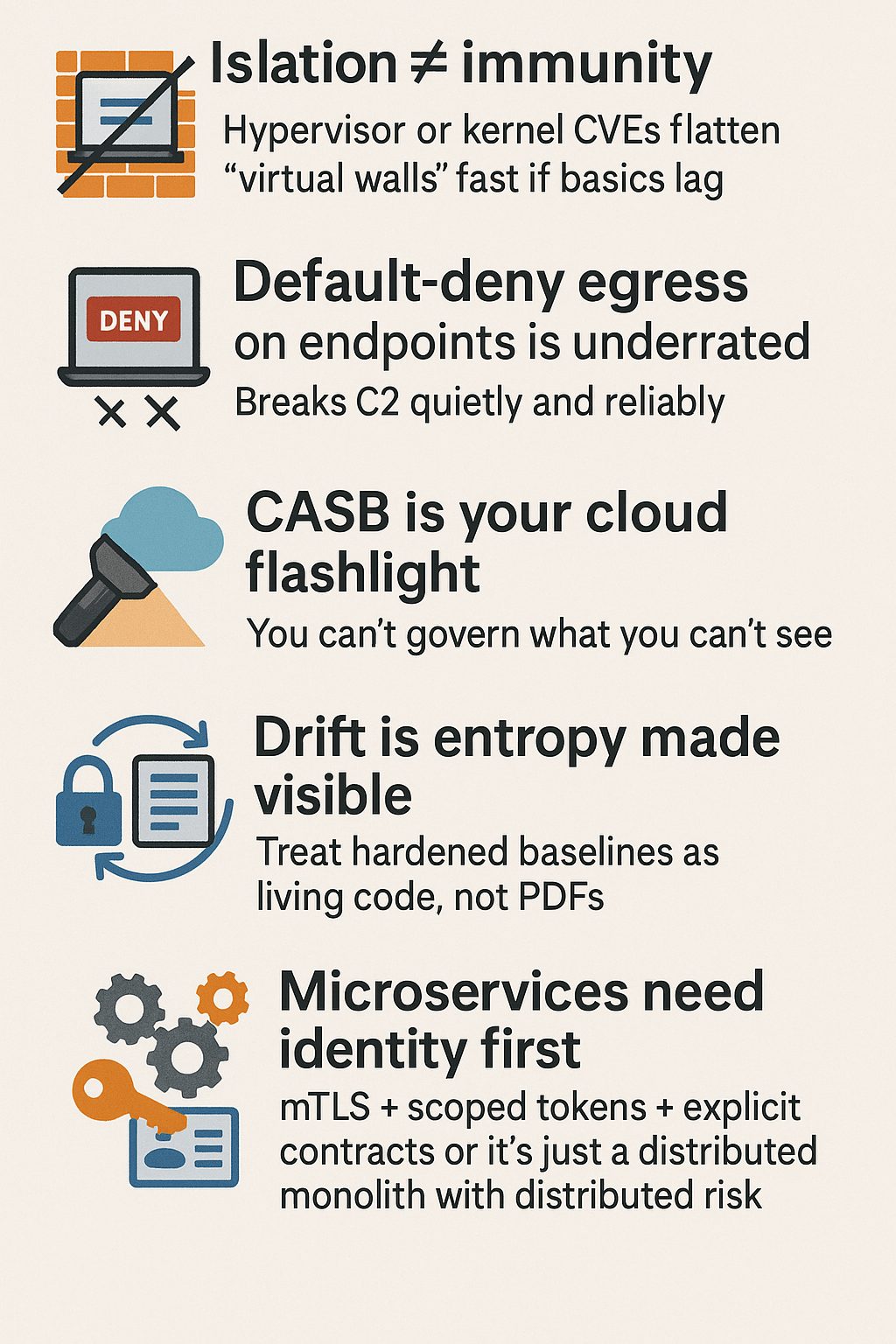
- Isolation ≠ immunity — hypervisor or kernel CVEs flatten virtual walls fast if basics lag
- VMs: strong isolation via hypervisor. Containers: moderate via namespaces/cgroups. Microservices: logical API boundary only
- Default-deny egress on endpoints is underrated — it breaks C2 quietly and reliably
- CASB is your cloud flashlight — you can't govern what you can't see
- Drift is entropy made visible — treat hardened baselines as living code, not PDFs
- Microservices need identity first — mTLS + scoped tokens + explicit contracts, or it's just a distributed monolith with distributed risk
- NIST cloud: 5 characteristics, 3 service models, 4 deployment models
- IaaS = most control + most responsibility; SaaS = least control + least responsibility