
Over the last few weeks I have been learning how stablecoin payments actually work. This is the first part of a short series where I explain what I understood, in plain language. This part covers the basic building blocks you need in order to follow everything that comes after, so I want to set them out in a way that is easy to read.
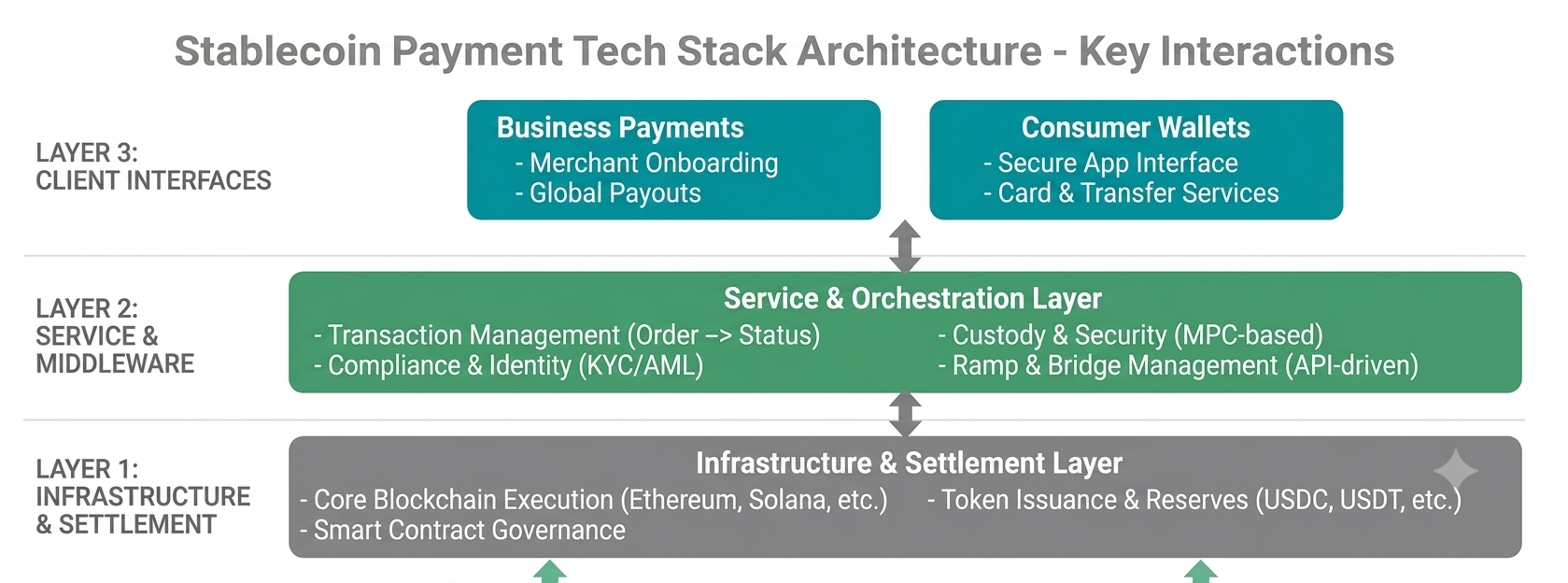
A stablecoin payment moves through three layers of technology. Each layer does a specific job, and each layer carries a specific kind of risk. In this part I explain the three layers one by one. For each layer I explain what it does, what it owns, and where the risk sits inside it.
The three layers at a glance
Exchanges ordinary money for stablecoins, and stablecoins back for ordinary money.
Issues, holds, moves and converts stablecoins on top of the blockchain.
Keeps the shared record of who owns what, and makes every payment final.
The blockchain sits beneath the other two as the shared foundation. The heaviest technical risk sits in the middle, where the keys are used. The heaviest regulated activity sits at the top, where real money is held.
The blockchain layer
What a ledger is
A ledger is a record of who owns what. Every bank keeps a ledger. When you hold money in your account, the bank's ledger has a line that says this amount belongs to you. The bank is the only one who keeps that record, and you trust the bank to keep it correctly.
What makes a blockchain different
A blockchain is also a ledger, but it is shared. Instead of one bank keeping the record, many computers around the world each keep a full copy of the same record. These computers are called nodes. When a new payment happens, the nodes check it and agree to add it to the record. Because every node holds the same copy, there is no single owner of the ledger, and there is no single place where the record can be quietly changed.
Immutability, and why it matters
Once a payment is written to a blockchain, it stays there. This property is called immutability, and it is also described as irreversibility. It means that once something is written, it cannot be undone. If you send money to the correct address, this is a good thing, because the payment is final and settled. If you send money to the wrong address, or if someone gains access to your account and sends it for you, the same property applies. The payment is final in that case too, and there is no central party who can reverse it.
Immutability is the property that makes a blockchain trustworthy, and it is also the property that creates the risk. In ordinary banking a wrong payment can often be recalled. On a blockchain the payment is final, so the control has to happen before the money moves, not after.
The orchestration layer
What orchestration means
The blockchain on its own is difficult to use directly. The orchestration layer is the software that sits on top of it and makes it usable for real payments. This layer issues stablecoins, holds them, moves them between parties, and converts one form of value into another. When a business wants to send a stablecoin payment through a simple instruction, the orchestration layer is what turns that instruction into an actual transaction on the blockchain.
Keys and key management
To move value on a blockchain, you need a private key. A private key is a secret number that authorises a payment from an address. Whoever holds the private key controls the assets at that address. The orchestration layer, together with the custody function connected to it, is responsible for generating these keys, storing them safely, and using them to sign transactions. This work is called key management, and it is the most sensitive job in the whole stack.
Key management carries two opposite failures. If a private key is lost, the money it controls can no longer be moved, and it stays frozen forever. If a private key is stolen, the money can be taken, and because the blockchain is irreversible, it cannot be recovered. A good deal of the governance work in this business exists to keep both of these failures from ever happening.
The private key is the money. Whoever holds it can move the assets, and the blockchain will treat that movement as valid. This is why key management is the single most important technical control in stablecoin payments.
The conversion layer, on-ramp and off-ramp
On-ramp and off-ramp
A stablecoin has value because it can be exchanged for ordinary money. The conversion layer is where that exchange happens. Moving from ordinary money into stablecoins is called an on-ramp. You give the provider euros or dollars, and you receive stablecoins of the same value. Moving from stablecoins back into ordinary money is called an off-ramp. You return the stablecoins, and you receive euros or dollars back into a bank account.
How you actually get your money back
This is the part that matters most to an ordinary user, because it answers a simple question. How do I turn this back into money I can spend. When you off-ramp, the provider takes back the stablecoins and pays you the matching amount in normal currency, usually by a transfer to your bank account. For this to work, the provider must hold real money in reserve to cover every stablecoin it has issued. The promise that one stablecoin can always be exchanged for one unit of currency only holds if that reserve is real and available at all times.
Where the risk sits, and where the regulation points
Once you see the three layers separately, a useful pattern appears. The technical risk and the regulated activity do not sit in the same place.
The heaviest technical risk sits in the middle, in the orchestration and key management layer, because that is where the keys are held and used. If that layer fails, value moves that should not move, and it cannot be undone.
The heaviest regulated activity sits at the edge, in the conversion layer, because that is where real client money is held and where stablecoins are redeemed. This is the layer that touches the traditional financial system, so this is the layer that financial regulation focuses on most.
The blockchain layer underneath is the shared foundation that both of these depend on. It is the record that makes the whole system final and trustworthy, and it sits beneath the other two rather than beside them.
For anyone working in governance, this separation is the useful part. The controls you design have to match where the risk actually lives, and where the risk lives is not always where the regulation points first.
| Layer | What it does | What it owns | Where the risk sits |
|---|---|---|---|
| Blockchain | Keeps the shared record of who owns what and makes every payment final | The record of ownership and the finality of settlement | Once a payment is written it cannot be undone |
| Orchestration | Issues, holds, moves and converts stablecoins on top of the blockchain | The movement of value and the private keys that authorise it | The keys are held and used here, so this is the heaviest technical risk |
| Conversion | Exchanges ordinary money for stablecoins and stablecoins back for money | The client money, the reserve and the redemption to fiat | Real client money is held here, so this is the heaviest regulated activity |
Where this goes next
That is the technology stack behind stablecoin payments. It has three layers, and each one has its own job and its own risk. The blockchain keeps the shared record and makes payments final. The orchestration layer moves the value and holds the keys. The conversion layer connects the whole thing back to ordinary money.
In the next part I explain why anyone would use this system at all. I follow a single payment from a business in France to a vendor in America. First I send it through SWIFT, then through SEPA Instant, and then through a stablecoin, so you can see exactly how each rail behaves and where the real difference lies.
A short glossary for this part
| Term | Plain meaning |
|---|---|
| Ledger | A record of who owns what. |
| Blockchain | A shared ledger held by many computers at once, with no single owner. |
| Node | A computer that keeps a full copy of the blockchain and checks new payments. |
| Immutability | The property that once a payment is written, it cannot be undone. Also called irreversibility. |
| Private key | The secret that authorises spending from an address. Whoever holds it controls the money. |
| Key management | The work of generating, storing and using private keys safely. |
| Stablecoin | A digital token that is meant to be worth one unit of an ordinary currency, backed by a reserve. |
| On-ramp | Exchanging ordinary money for stablecoins. |
| Off-ramp | Exchanging stablecoins back for ordinary money. |
| Reserve | The real money the provider holds to cover every stablecoin it has issued. |
| Redemption | Returning a stablecoin and receiving ordinary money back for it. |