
Part 2 ended on a simple observation. Stablecoin payments are fast and far reaching because they remove the chain of banks in the middle. Those banks did more than pass the money along though. They also provided protection. They could check a payment, hold it, and reverse it when something went wrong.
This part looks at what happens once that protection is gone. The theme running through all of it is the same. Traditional payments carried their safety nets inside the system. Stablecoin payments strip several of them out, so the risk has to be managed somewhere else, and it has to be managed before the money moves rather than after.
Irreversibility and the loss of the chargeback
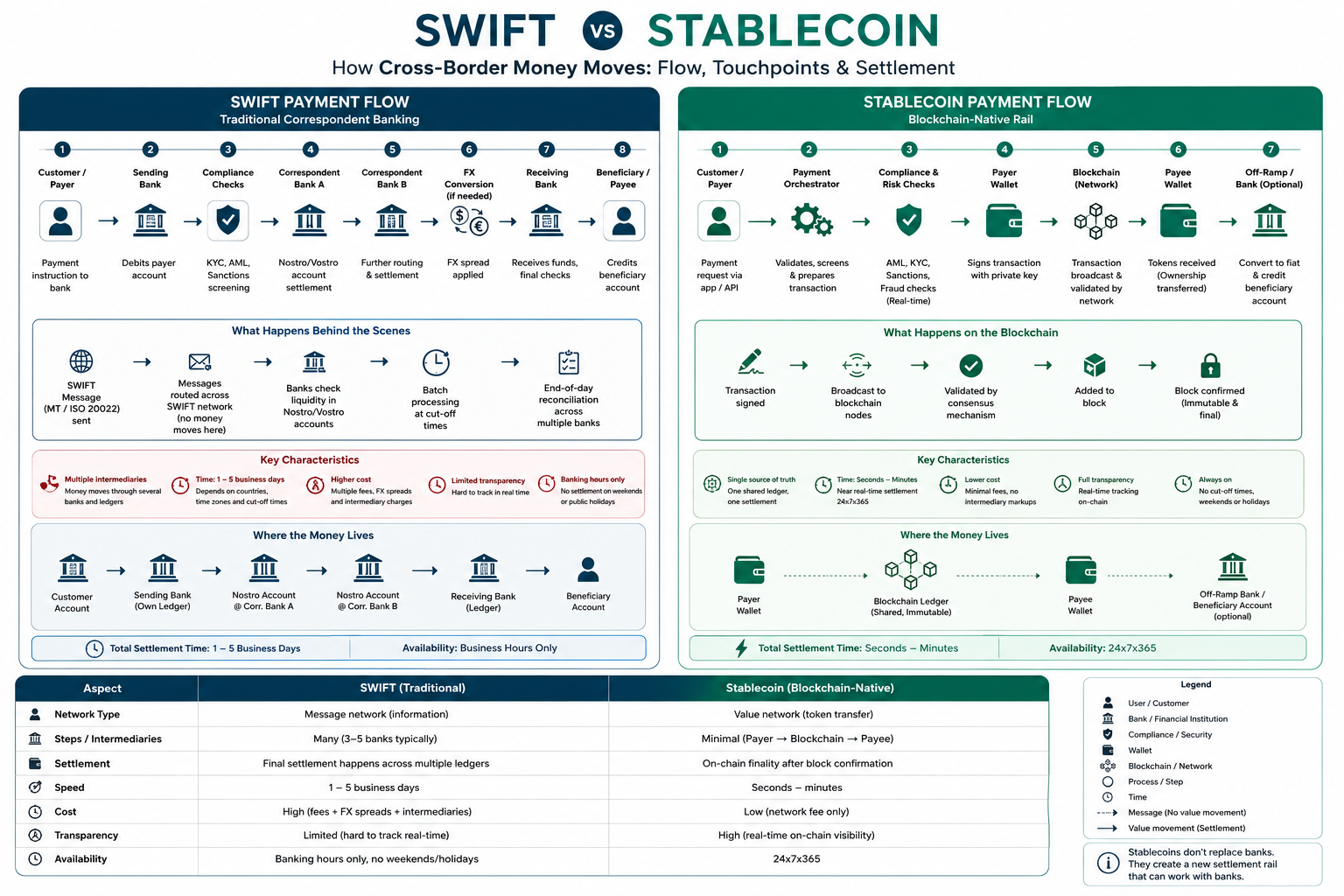
In card and bank payments, a payment made by mistake or through fraud can often be undone. A card payment can be charged back. A bank transfer can sometimes be recalled. There is a central party who can step in and reverse the movement.
On a blockchain the payment is final. Once value reaches the wrong address, or reaches a criminal, it stays there. There is no central party to reverse it, and there is no button to press. This single fact changes how the whole business has to be run. In traditional payments you can fix many problems after they happen. Here you cannot, so the checking has to happen before the money leaves, because afterwards is too late.
Crypto removes the chargeback. The protection it used to provide has to be rebuilt through controls and through regulation, because the payment itself can no longer be reversed.
Key management, the risk that can end the business
Part 1 explained that the private key controls the money. This is the risk that matters most of all. If a key is stolen, the money it controls can be taken, and because the payment is irreversible it cannot be recovered. If a key is lost, the money it controls is frozen and can never be moved again. There is no bank to call and no password to reset.
Because of this, everything about how keys are handled becomes a serious matter. Keys are often split into several parts so that no single person and no single system holds the whole key. Moving money then needs several parts to come together, which means several people or systems have to agree. These arrangements exist so that one dishonest insider, or one attacker who breaks into one account, cannot move the money alone.
Insider risk and fraud
Because moving money only needs the key, the greatest threat sits close to the key. A trusted insider with the right access could move funds. An attacker who takes over that insider's access could do the same. In a bank, many layers and the ability to reverse a payment help catch this kind of thing. In stablecoin payments there is no reversal, so the prevention has to be stronger and it has to work the first time.
This is why the controls around people matter as much as the controls around technology. Splitting approval across several people, separating who can request a payment from who can approve it, and limiting who can go near the keys are all there to remove the single point where one person could cause a loss that cannot be undone.
Peg and reserve risk
A stablecoin is worth one unit of currency only because someone holds real money in reserve to back it. The promise is that you can always exchange one stablecoin for one unit of the currency it tracks. That promise holds only while the reserve is real, fully sized, and available whenever people ask for their money.
If the reserve is not fully there, or cannot be reached when many holders want to redeem at the same time, the stablecoin can fall below its promised value. This is called a depeg. Ordinary bank deposits do not carry this exact risk, because they sit inside a regulated and protected system. For a stablecoin, the strength of the reserve is the strength of the promise, so managing and proving the reserve is central to the whole idea.
On-chain transparency and the privacy tension
A blockchain is public. Anyone can look at the flow of value between addresses. This has a good side, because the record is open and cannot be quietly altered, which makes it easy to audit. It also creates a tension around privacy, because payments can be traced and patterns can be linked back to people and businesses.
So the work here is to keep the record honest and open while still protecting the privacy of customers. Deciding who is allowed to see what, and keeping personal and commercial information safe on a public system, is a real part of running stablecoin payments well.
The pattern behind all of these risks
Seen together, these risks share one shape. Traditional payments held their protections inside the system. A payment could be reversed. A central authority could step in. Deposits were protected. Ledgers were private. Stablecoin payments remove several of these at once.
That does not leave the system unprotected. It means the protection has to be rebuilt on purpose, in two places. It is rebuilt through controls, which is how a firm runs its keys, its approvals and its people. And it is rebuilt through regulation, which sets the rules the whole market has to follow. Those two rebuildings are the subject of Part 4 and Part 5.
Traditional payments and stablecoin payments side by side
| Risk area | In traditional payments | In stablecoin payments |
|---|---|---|
| Fixing a mistake | A payment can often be reversed or recalled | The payment is final and cannot be reversed |
| Who holds the money | A regulated bank holds it for you | Whoever holds the private key controls it |
| Losing access | The bank can restore access to your account | A lost key means the money is frozen forever |
| Value stability | A euro in the bank stays a euro | The value holds only while the reserve behind it holds |
| The payment record | Kept privately by your bank | Visible to anyone on a public ledger |
Key takeaways
A short glossary for this part
| Term | Plain meaning |
|---|---|
| Chargeback | Reversing a card payment after it was made, usually to protect the buyer. |
| Peg | The fixed value a stablecoin is meant to hold, such as one euro or one dollar. |
| Depeg | When a stablecoin falls below the value it is meant to hold. |
| Reserve | The real money held to back every stablecoin in circulation. |
| Segregation of duties | Splitting a task so the person who requests something is not the person who approves it. |
| On-chain | Recorded directly on the public blockchain. |